.svg)

.svg)
The insurance industry is rapidly bifurcating into two distinct categories: Agile API-First Leaders and Legacy Laggards. For CUOs and CTOs, the margin for error has evaporated. We are entering an era of zero-touch commerce, where the future of insurance is executed by autonomous entities via Agent-to-Agent (A2A) workflows. If your infrastructure cannot support this next generation of distribution, you will be outpaced and acquired for parts.
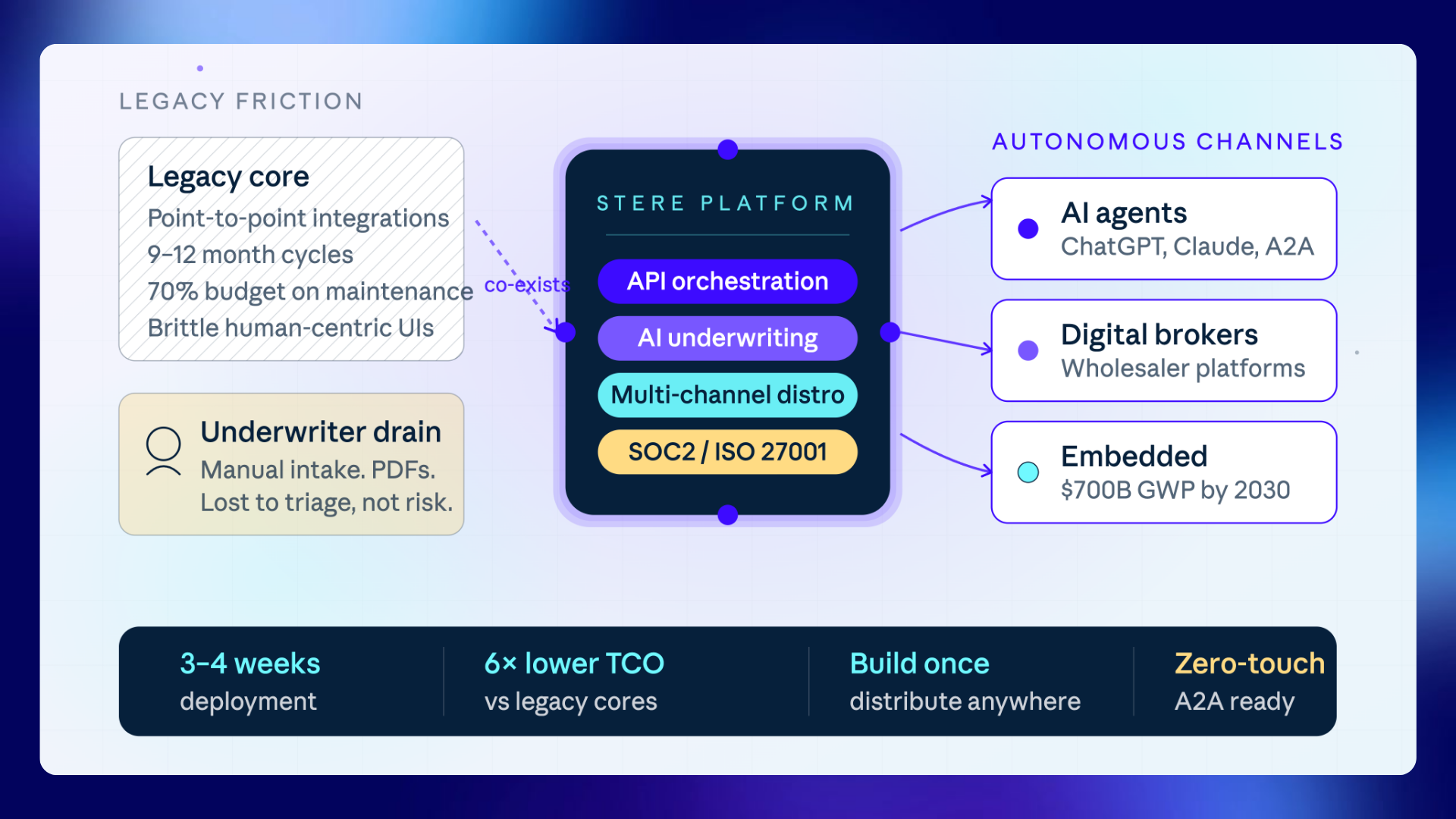
The harsh reality is that highly paid, experienced underwriters are drowning in manual, low-value work. They spend a significant portion of their day on administrative tasks like data entry and triaging submissions instead of on complex risk analysis. Simultaneously, IT departments are trapped by technical debt, maintaining rigid legacy systems that drain up to 70% of the IT budget just for maintenance. This dual crisis—underwriting burnout and IT bottlenecks—is actively destroying market share.
Your most valuable underwriters are buried in manual noise. Every minute an expert underwriter spends doing manual data entry from unstructured emails and PDFs is a minute lost on profitable risk analysis. Your competitors are executing Underwriting 2.0 to triage complex risks in milliseconds. If your team is stuck navigating unstructured legacy systems and dealing with high-latency responses that break autonomous execution, top talent will leave for tech-forward competitors.
The pain is acute. The lack of a single view of risk and modern tools for accurate, real-time risk assessment directly leads to underwriting leakage and missed opportunities. Furthermore, the intense pressure to increase speed-to-quote to win business from brokers means that slow, manual processes actively cost you premium. You are losing profitable business simply because you cannot quote fast enough. It is time to automate the noise and free your experts to underwrite.
For the CTOs, the underlying infrastructure must transition from human-centric screens to machine-readable APIs. Entrenched legacy competitors aggressively sell monolithic core replacements disguised as modernization. They attempt to solve the AI deficit by simply slapping generative LLM wrappers onto human-centric graphical user interfaces. This fundamentally misses the mark. Human-centric screens actively break multi-agent orchestration loops.
If you rely on point-to-point, brittle integrations for each new channel, you are creating a technical debt trap. Custom, non-reusable projects are slow, expensive, and impossible to scale efficiently. The 9-12 month development cycles typical of legacy systems hinder the ability to adapt to market opportunities. You must innovate without the risk, eliminating the immense risk, cost, and time of a full replacement.
Stere provides the strategic platform to escape these issues. We do not sell a policy administration system; we sell the freedom to innovate at speed. Stere is the API-first platform that can bridge your legacy core with the digital world. It allows you to wrap your legacy core in a secure, SOCII and ISO 27001-certified environment, acting as the essential connective tissue for broker and carrier AIs to negotiate and bind autonomously.
This "co-existence" strategy is a profound advantage. Stere operates alongside your legacy core to orchestrate data and distribution, feeding data back into your existing system of record in real-time. You gain radical speed with 3-4 week deployment cycles for new products, empowering you to innovate on the edge without disrupting your main core.
To achieve zero-touch commerce and straight-through quoting, we must ruthlessly translate technology capabilities into strategic outcomes.
Scaling outbound distribution requires a fundamentally different technical architecture.
With the underwriting process automated and the API infrastructure secured, MGAs and insurers can unleash a true outbound distribution strategy. Distribution through digital broker and wholesaler platforms, AI platforms like ChatGPT, and furthermore the embedded insurance opportunities that is projected to grow to $700 billion in GWP by 2030. You cannot capture these opportunities with a 12-month integration backlog.
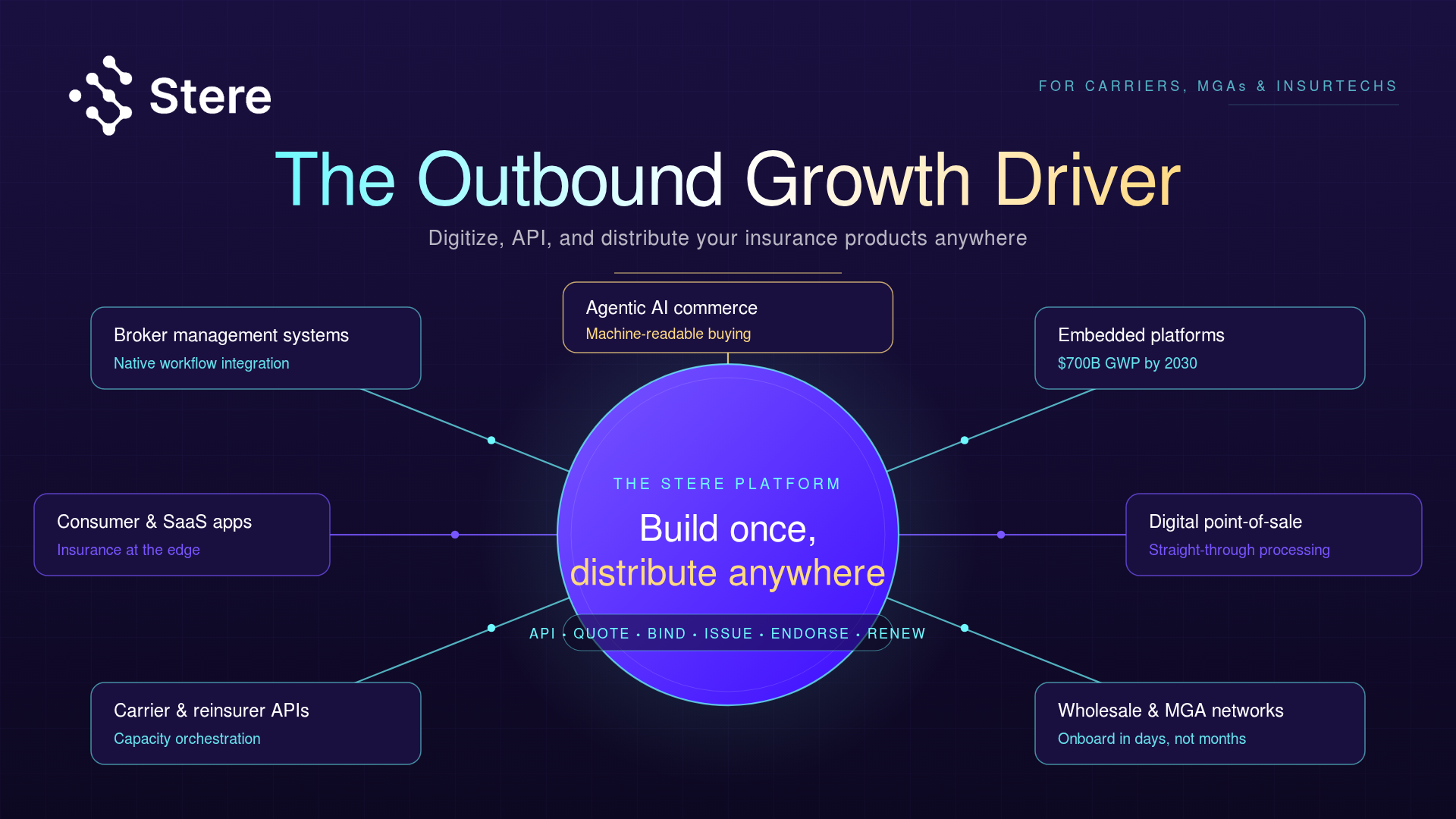
Stere's Multi-Channel Distribution architecture allows you to build a product once and distribute it anywhere. You can deploy a single product across brokers, wholesalers, digital platforms, and embedded channels instantly, without building custom integrations for each one. Stop building integrations and start scaling premium.
The industry is moving to autonomous commerce at lightspeed. Stop building screens for humans. By adopting Stere Platform, you automate the noise, free your experts, and innovate without the risk. You achieve a 6x lower total cost of ownership compared to traditional legacy systems, drastically reducing your budget drain. The choice is clear: remain constrained by legacy technology, or leverage Stere to orchestrate AI-driven, zero-touch commerce and scale distribution infinitely.
.svg)
Copyright © 2024. All Rights Reserved