.svg)

.svg)
The insurance industry is currently undergoing a brutal, rapid bifurcation. On one side are the agile, API-first leaders capturing market share in milliseconds. On the other side are the legacy laggards, drowning in technical debt and bleeding top talent because they are paralyzed by the limitations of their own infrastructure.
For the modern Chief Information Officer (CIO), the pressure has never been more intense. You are tasked with driving the company's digital transformation agenda, reducing IT operational costs, and increasing business agility. The business side is relentlessly demanding new capabilities, faster product launches, and seamless connectivity to emerging digital distribution channels.
Yet, as an IT leader, you are intimately aware of the grim reality: you are trapped.
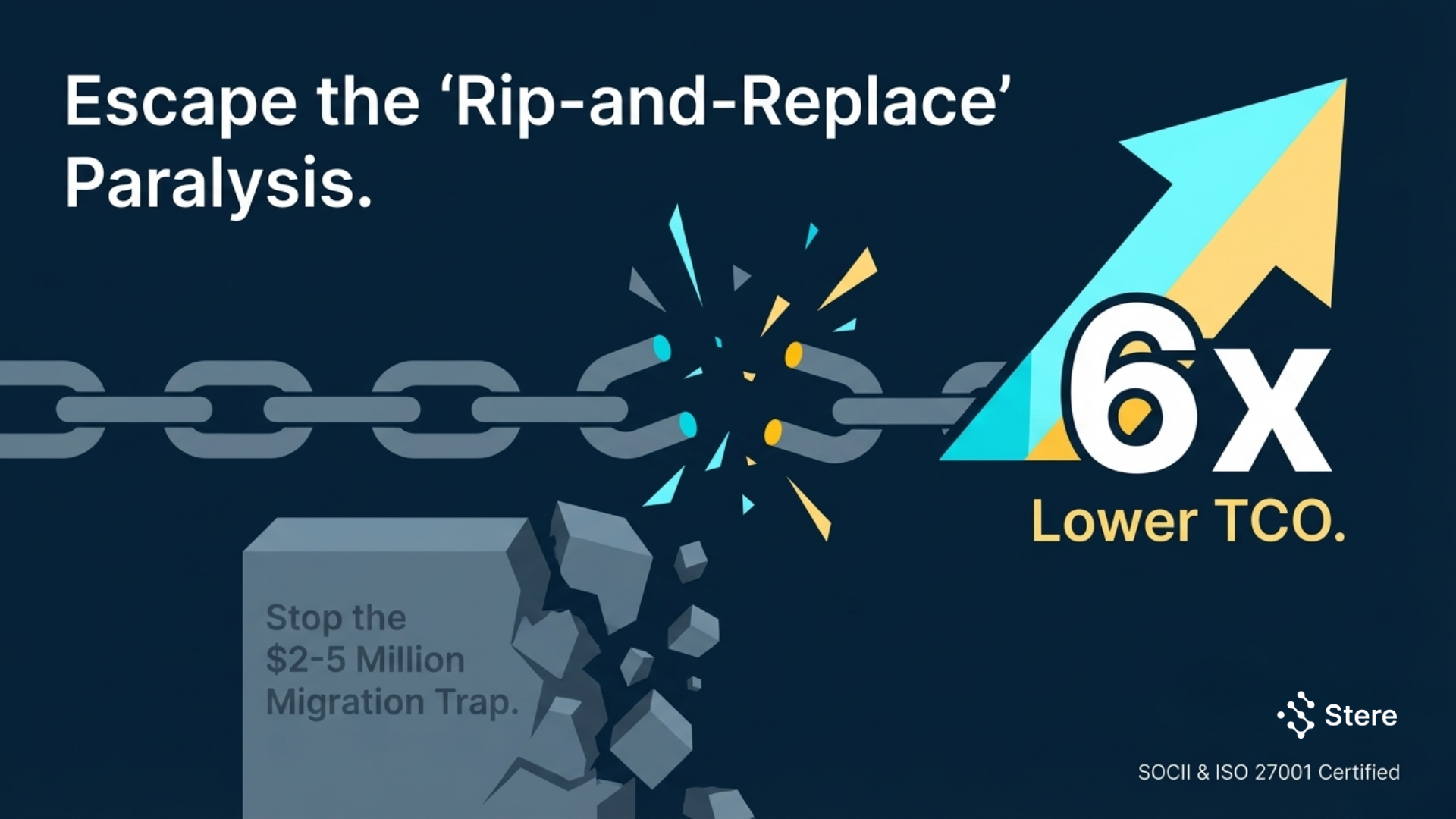
Your legacy systems are a constant drain on resources, consuming up to 70% of the IT budget just for maintenance. These entrenched systems—the very systems of record that keep the lights on—are notoriously slow, expensive, and inflexible. A typical product deployment on these legacy architectures can take 9-12 months and cost $2-5 million in licenses, not including high payroll costs.
This is the multi-million dollar trap. And the proposed "solutions" being peddled by the market are often worse than the disease.
To escape the legacy trap, many CIOs are being aggressively sold on "modern core" replacements by vendors who promise cloud-native agility. However, their primary value proposition is centered on a full "rip-and-replace" of the existing core.
Let’s be honest about what a "rip-and-replace" actually means for an established enterprise insurer. It represents a massive, high-risk, multi-year project. It means freezing innovation for years while your engineering teams attempt to migrate decades of complex, proprietary business logic and massive datasets to a new environment. It creates significant organizational friction and a notoriously long sales cycle. For the CIOs of these organizations, the immense risk, cost, and time involved make this approach a non-starter.
This dynamic creates what we call "rip-and-replace" paralysis. You know the current system is unsustainable, but the cost and risk of the cure feel fatal.
While you are stuck evaluating multi-year migration plans and attending 18-month API strategy meetings, the market is moving on without you.
The primary "user" of insurance software in 2026 is an autonomous machine. Agent-to-Agent (A2A) protocols are negotiating and binding coverage in milliseconds. The embedded insurance market is projected to grow to $700 billion in GWP by 2030, representing a seismic shift in distribution.
To try and keep up without replacing the core, many IT teams resort to patching their legacy systems. You build point-to-point, custom integrations for every new distribution partner. You wrap public LLM APIs into human-centric workflow portals.
This is a dangerous stopgap. These inefficient, non-reusable custom integrations create a brittle technical debt trap. Every new patch makes the system more fragile. Every new custom connection increases the security surface area. Eventually, this house of cards will collapse, rendering your tech stack entirely obsolete while your competitors—operating on clean, un-opinionated API architectures—scale effortlessly.
If your core system requires a human to click a button, you are already obsolete.
You do not need to replace your core to transform your business. You need a middleware layer that connects new channels to old systems.
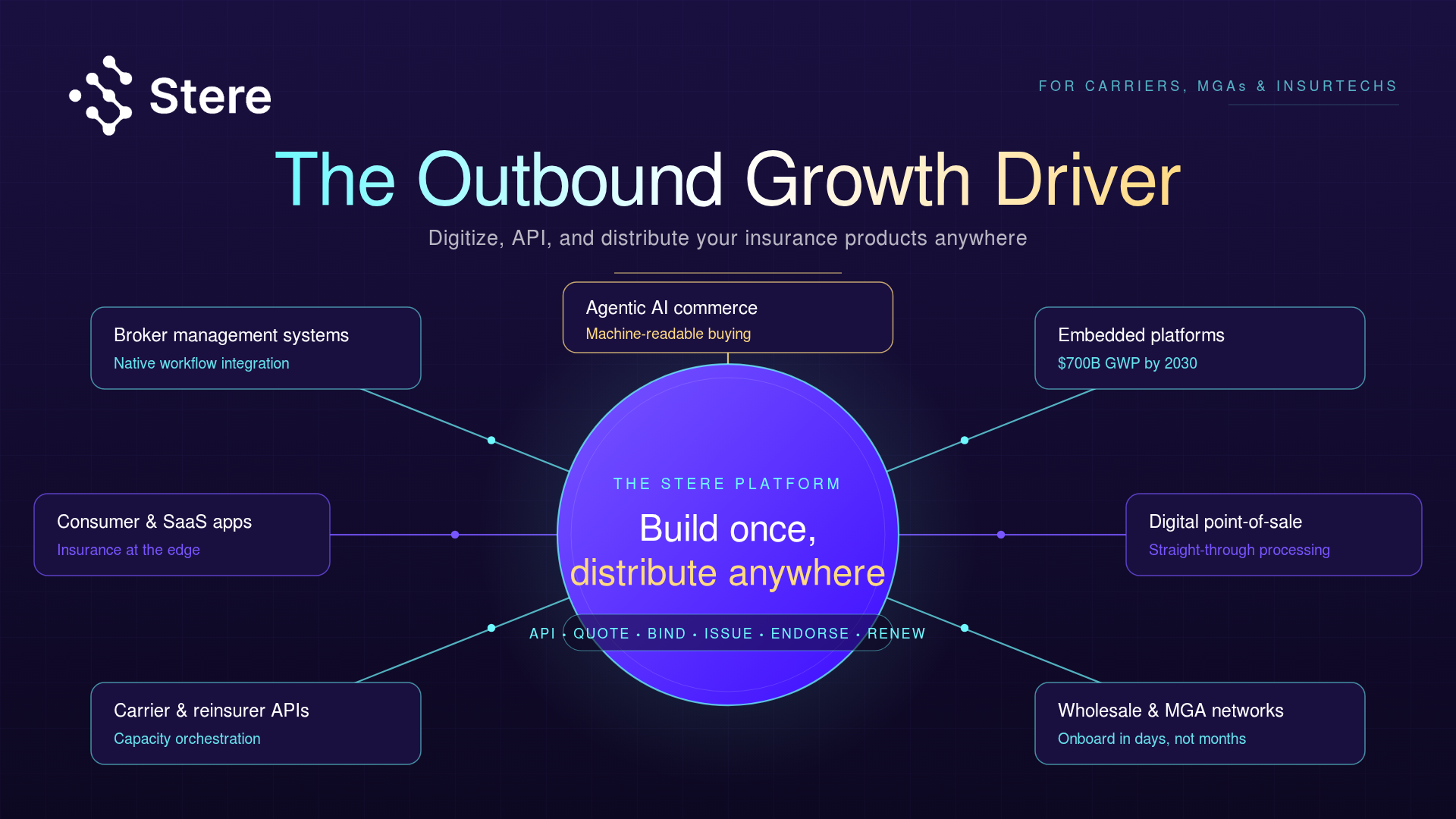
Stere is the API-first middleware that bridges your legacy core with the digital world. We offer a fundamentally different architectural approach designed explicitly to cure "rip-and-replace" paralysis.
Instead of demanding a high-risk overhaul, Stere’s platform has a unique and deliberately engineered capability: it can "co-exist with your current legacy system" and provide a "data feed" back into it in real-time.
The Feature: Co-existence with legacy systems. The Benefit: The ability to deploy Stere for new products and channels while feeding data back into the existing core system of record in real-time. The Outcome: For the Innovator (CIO), this allows you to de-risk digital transformation. You achieve speed and agility now without the cost, time, and massive organizational disruption of a full "rip-and-replace" project.
By deploying Stere's middleware on the edge, you can launch new digital products in 3 weeks without disrupting your mainframe. We provide the modern microservices and API infrastructure you need to launch digital products and connect with partners, while your system of record remains secure and untouched.
This is how you break free from the technical debt trap. You stop building brittle, custom integrations for every new partner. Instead, you utilize Stere's Comprehensive API Suite, acting as a universal adapter, allowing you to plug into brokers, wholesalers, embedded partners, and digital platforms instantly.
In an API-driven world, security is the ultimate feature. When bypassing the legacy core to innovate on the edge, CIOs must be certain that they are not opening the enterprise up to unacceptable risk.
Stere is built on enterprise-grade infrastructure, validated by SOCII and ISO 27001 certifications. These certifications are not footnotes; they are core differentiators and powerful reasons to believe.
We allow CIOs to innovate on the edge with absolute confidence, knowing their data flows through a fortress that meets the rigorous compliance standards of the world's largest financial institutions. Gain the confidence to partner and innovate, knowing the platform meets the highest standards for data security, privacy, and governance.
Your legacy core isn't just an IT problem; it's a business growth problem. It is costing you more than just maintenance fees—it is costing you market share.
By adopting an "Insurance PaaS" (Platform-as-a-Service) model, you fundamentally alter the economics and velocity of your IT department. You move from spending 70% of your budget on maintenance to offering a 6x lower total cost of ownership (TCO) compared to traditional legacy systems.
More importantly, you move from being perceived as a cost center to being a strategic partner to the business.
At Stere, our narrative transcends the technical features of the platform to focus on the ultimate outcome for our clients: liberation. We do not just sell software; we sell Strategic Freedom. We sell the freedom to innovate at speed.
Escape the "rip-and-replace" paralysis. Liberate your data, free your developers, and stop patching brittle integrations. Innovate without the risk, and build the secure, Sovereign AI-ready foundation for your autonomous future today.
#InsurTech #LegacyModernization #CIO #StrategicFreedom #APIFirst #RipAndReplaceParalysis #DigitalTransformation #InsurancePaaS #TechnicalDebt #FinTech #ITStrategy
.svg)
Copyright © 2024. All Rights Reserved