.svg)

.svg)
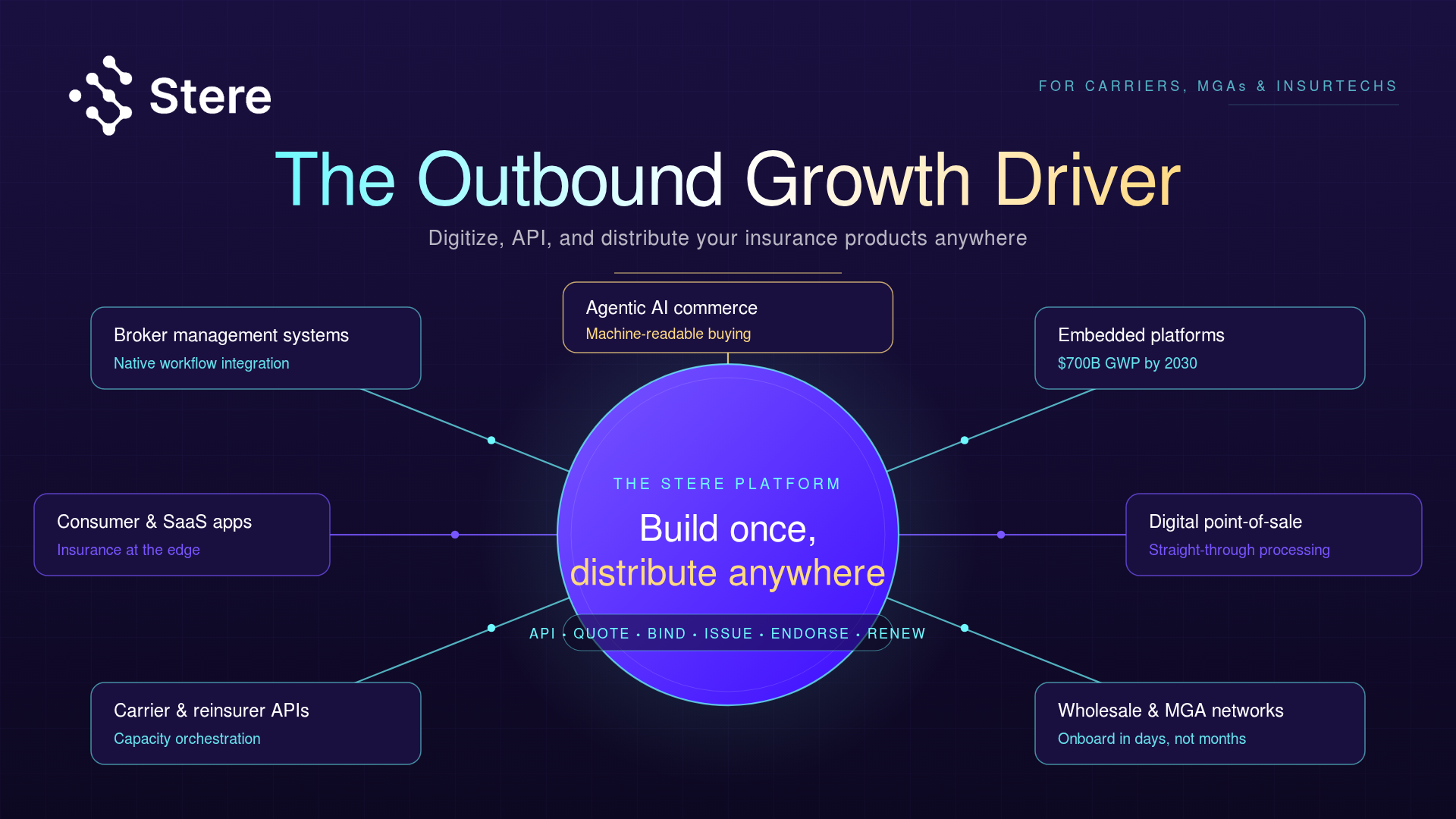
For years, Carriers and MGAs have relied on a passive "inbound" strategy. You built a portal, gave brokers the login, and waited for them to bring you business. That model is no longer sufficient to hit aggressive growth targets. Today, brokers and customers expect insurance to meet them where they already operate—inside their own proprietary management systems, digital point-of-sale platforms, and embedded retail experiences.
If your products cannot instantly integrate into these external ecosystems, you are invisible. Competitors with modern infrastructure are already onboarding distribution partners in days via APIs, aggressively stealing your premium and market share while you wait for your IT department's 12-month integration backlog. It is time to stop building single-use integrations and start scaling premium. It is time for a radical outbound strategy.
To understand the infrastructure needed for an outbound strategy, we must define the new baseline of insurance commerce:
The growth ambitions of the modern Distributor are frequently blocked by technology. The core problem is that legacy core systems lack native, modern APIs. Therefore, every time you sign a new distribution partner, your IT team must build point-to-point, brittle integrations.
This creates a terrifying reality for revenue leaders: the business wants to capture first-mover advantage in emerging markets and niches, but slow product development cycles mean you can't capitalize quickly enough. The opportunity cost is staggering. Every month spent negotiating IT sprint resources is a month of lost premium to an agile MGA or tech-forward carrier.
To reverse this trend and unlock exponential scale, you need an architecture that acts as a universal adapter. Stere provides an end-to-end API-first platform built precisely for this capability.
Here is how the transition from inbound to outbound works using the Feature → Benefit → Outcome framework:
When Axa partnered with CorX broker platform to launch a small commercial and a group life product, they didn't embark on a multi-year IT integration. Using Stere, they deployed the product with full API support in a couple of weeks. That is the speed required to win.
A common objection from IT when revenue leaders push for modern API distribution is the fear of disrupting the core system of record. Stere neutralizes this objection. Stere operates as a "co-existence" PaaS (Platform as a Service). We are the middleware that bridges your legacy core with the digital world.
You deploy Stere to instantly unlock massive new distribution channels at the edge, while our platform securely feeds data back into your legacy system of record in real-time. You achieve speed and agility now, without the cost, time, and massive organizational disruption of a full "rip-and-replace" project.
By digitizing and API'ing your product for all lifecycle events, you remove the friction for brokers and embedded partners to sell your product. Instead of forcing a broker to leave their workflow to log into your portal, your product lives natively in their system. This ease of doing business directly correlates to increased bind rates and premium volume.
No. Stere's SaaS and PaaS platforms provide the comprehensive, well-documented API suite out-of-the-box. This allows your distribution partners to consume your APIs effortlessly, acting as an innovation toolkit that doesn't demand heavy lifting from your internal IT.
Innovation requires confidence. Stere is built on enterprise-grade infrastructure and is validated by SOCII and ISO 27001 certifications. Your technology partner must be a fortress. We empower you to onboard digital partners rapidly while mitigating cybersecurity risk for the entire organization.
The brokers demanding straight-through processing via their own APIs will not wait. If you continue to treat integrations as bespoke IT projects, you will be outpaced by competitors who view connectivity as a native utility. Deploy Stere's "build once, distribute anywhere" architecture, stop building single-use integrations, and start scaling your revenue across every possible channel.
.svg)
Copyright © 2024. All Rights Reserved